
Never think that Australia might be growing up. You’ll only be disappointed. It’s only ever an illusion — no matter how sensible our culture might seem next to the Americans, no matter how healthy our politics looks next to the English. We’re in the habit of looking north and rolling our eyes, but it’s a habit we should break. We might not yet be deranged, but we remain children.
I had my own illusions of Australia’s moral growth shattered this week. I’m not sure how else to see the treatment of Usman Khawaja in terms other than national juvenilia. What I have seen these last few days is so moronic, so idiotic, so childish that I feel embarrassed on behalf of my countrymen, and embarrassed, of course, of myself.
Eight years ago, Australia’s naive self-mythology was shattered by the discovery that the national cricket team had been cheating. They had been rubbing the ball with sandpaper to extract reverse swing. The national response, I thought at the time, was something to be proud of: a ferocious rebuke that included the banning of the best player in the world for a year. It was a far more severe response than I would have expected from other cricketing nations. Three players, all batsmen, were stood down. One of the three never played for Australia again.
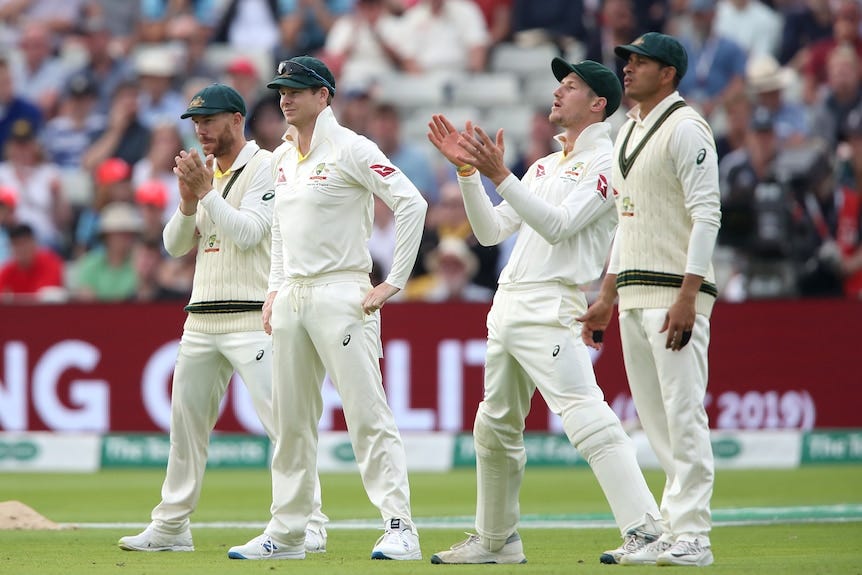
Now, 8 years later, Khawaja has stepped forward to say it was not just the three players who were guilty — the whole team, including the staff, knew. He argues, clearly if not eloquently, that those three players were scapegoated. He argues, that is, that the team was too immature to accept responsibility. By extension, so was the nation.
For calling the team out on their moral immaturity, Khawaja has been subject to extreme backlash from the mob. They level two accusations against him. First, that he should have spoken up 8 years ago. And second, that his aim now is to make money by selling books.
These accusations are amazing in their stupidity. They suggest, unbelievably, that Khawaja could have stood alone against the national team, cricketing establishment, and national psyche without jeopardising his career – when telling the truth nearly a decade later has led to paroxysms across the country. And, maybe even more incredibly, they suggest that it’s possible to make money selling books in 2026.
Khawaja’s motives are impugned and his character is attacked, but no one is willing to say explicitly that he is a liar. But how could they? He is so plainly telling the truth: if you think a professional fast bowler can’t tell that his cricket ball has been rubbed with sandpaper, may God help you. Of course the whole team knew. The scapegoating of Cameron Bancroft, David Warner, and Steve Smith may have been more punishment than other countries would have dolled out, but it was less than what the whole team deserved.
Which is to say the scapegoating served its social function. Scapegoating allowed the Australian cricket team, and the Australian public, to deflect uncomfortable emotions — like guilt, anxiety, and accountability — onto a convenient target. Bancroft, Warner, and Smith played their roles perfectly: the impressionable youngster, the forceful bully, and the tragic, but ultimately responsible, captain. They bore the sins of the team.
We were not mature enough to do the right thing then, and we are not mature enough to do the right thing now. The nation remains juvenile. Faced with uncomfortable emotions, we once again seek to offload them onto a convenient target. We turn again to scapegoating. And this time round it is Khawaja who makes the ideal target. He plays his role perfectly. He is both the troublemaker and the do-gooder. He’s always both stirring things up and making things about him. And, yes, as the non-white member of the team, he can be made into the outsider — and accused of “playing the race card” if he complains about it.
What he is stirring up, ultimately, is Australia’s awareness of its own moral failing. This is the aversion to responsibility that we see in children. I’m reminded now of something I wrote two years ago, observing the same dynamic in the US:
…I’m pointing to a repeated historical pattern, as present today as in 1854, in which people are so shamed by the presence of moral virtue that they do anything to dismiss it. So much of the broad “moderate” reaction to protest, I’m saying, comes from the knowledge that the dissidents are right and brave. Bravery makes us aware of our own cowardice, and that is an awareness we cannot bear. Better to find a way to explain away the need for protest than face the possibility of acting.
Australia’s moron brigade, Australia’s keyboard warriors, Australia’s mob – they cannot conceive of a man acting from principle rather than self-interest, so they invent base motives for him. This is why their accusations are both so fanciful and so strongly felt. We are experiencing the guttural cry of the mob seeking to offload its uncomfortable emotions — guilt, complicity, and shame among them. We have here the mere reactionary impulse.
Mere reaction, remember, is deeply felt because it is always a wholly affective response to a social situation. This collective mood takes over groups and propels them to lash out; to kick down; to exile the source of their negative feeling. The mob is this base social psychology in action; it is, as I’ve said, the juvenile posture enacted at the level of society. The higher cognitive states are not accessed. It’s the infantile nation.
I can’t help but end with the old line from Trilling:
“It is the plain fact that nowadays there are no conservative or reactionary ideas in general circulation. This does not mean, of course, that there is no impulse to conservatism or to reaction. Such impulses are certainly very strong, perhaps even stronger than most of us know. But the conservative impulse and the reactionary impulse do not, with some isolated and some ecclesiastical exceptions, express themselves in ideas but only in action or in irritable mental gestures which seek to resemble ideas.”
Agree. And it’s pretty interesting that despite all of his great achievements, the juvenile crowd are trying to make sure he is remembered for “breaking the code of men’s locker room silence”, rather than the amazing person he was/is.