
To get anything like a half-reasonable response to the scandal engulfing Australian cricket, and therefore Australia, you have to look overseas. The Poms, if not the Saffas, have attended to this fiasco with thoughtfulness. But not here.
That is because every voice in the Australian sporting commentariat is compromised. We have here boys clubs within boys clubs. We have here intermarried sporting dynasties and intermarried media dynasties marrying into sports-media dynasties. We have Cricket Australia contracts and Weetbix contracts and the sports gambling lobby looming over it all. We have Australia’s Old Money sitting in the Members’ and its proletariat swaying in Bay 13. Both can be found in the Instagram comments.
White Australia is divided by the football codes, but it is united by the cricket; South Asian Australia, I should add, is with them, too. It is the continent’s dominant cross-class values-forming institution. The sport is entangled with Power in this country in profound and complicated ways. Any person who “doesn’t get” “why people care” about “something that happened years ago” is not a person incurious about cricket: they are a person incurious about Australia.
The scandal itself has now devolved into a stalemate of competing testimony between “the bowlers” — which is to say the tall, regal, softly-spoken but world-dominant pace attack of Pat Cummins, Mitchell Starc, and Josh Hazelwood — and “the batters”, by which is meant the vocal pair of Khawaja and Warner on one hand, and the still-tight-lipped Bancroft and Smith on the other. Of “the batters”, only Smith remains in the team, though his own great star is fading.
What makes this bitter divide more intriguing are the bizarre political coalitions now forming around it, scrambling Australia’s culture war into unrecognisable forms. The bowlers, who, after Sandpapergate, took ascendancy inside the team and so effectively rehabilitated its image that Australia’s right wing accused them of wokeness, now find themselves opposed by a group including Pakistani-Australian Usman Khawaja, who to the popular media represents diversity, inclusion, and all things annoying, and Howard’s Battler David Warner, standing in for the True Blue low-SES white Australian. They make an odd pair, these two childhood friends. One stands in solidarity with the victims of the IDF; the other stands with victims of the RBT.
This scrambled coalition may have disoriented Australia’s media at first, but they have stuck true to their North Star of mere reaction. Troublemakers, snitches, holier-than-thous — anyone who speaks up against the in-group must be dealt with and disarmed. As I wrote the other day, race, of course, comes into it — in Australia, how could it not? So that too has to be deflected. Cummins on Friday was quick to dismiss the notion that race ever affected Khawaja’s selection, or his chances of being made captain. Suddenly the woke captain is being aligned with the conservative press, and he is once again their favourite.
And so we see new fault lines in our culture begin to emerge. “Real leadership” and a “captain’s knock” became the party lines. Sottovoce: he has fought off the troublemaker.
Longtime readers will know this blog favours the effete wokeness of the Cummins of old. We’re all sipping lattes around here. Perhaps that is why the captain’s press conference looked to me more like tragedy than triumph. Cummins, at the podium, denied, and denied, and denied. But the shape of his denial, to my ear, sounded a lot like admission.
For nearly a decade, the bowlers have stuck ferociously to a narrow and technical account of what happened in Cape Town. In every public statement, they have said explicitly that they were not aware that sandpaper would be “taken onto the field”. This denial has worked for them exactly because it is most likely true and because Australia’s cricket media has been too lazy, or too uninterested, to pin them down with follow-up questions. The question to ask, of course, is whether the bowlers knew that sandpaper was being used to tamper with the ball at all.
Khawaja’s book is explicit that the first plan was to apply sandpaper on the boundary, off the field, and relatively out of sight. It strikes me as entirely plausible that the bowlers neither knew of nor consented to the use of sandpaper on the field, and would have objected loudly had they known. For reasons that are now obvious, that would have been very stupid. But it strikes me as utterly implausible, to the point of absurdity, that a professional cannot tell that his own ball has been manipulated at all.
Any person who has had a trundle, be it in the backyard or the Gabba, knows how much time a bowler will spend scanning the condition of his ball. This is one of the great joys of cricket! One attends to the ball as though it were a baby, and every time it passes through his hands, which is to say every ball, he takes note of its changing.
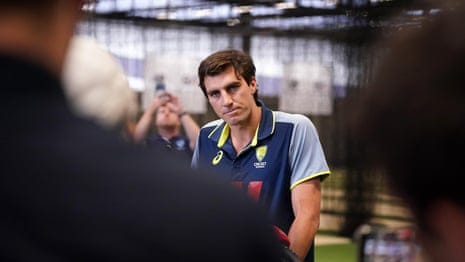
This is why I found Cummins’ press conference to be so dismaying.
“When he says that ‘we all knew’”, opened Cummins, “if by that he means that we knew sandpaper was going out on the field, [he is] 100% wrong.”
It is a stunningly and suspiciously narrow denial: not, as far as I can tell, even close to what Khawaja meant. Khawaja spoke of a general awareness to apply sandpaper to the ball — he didn’t mention a time or place, nor a master plan. But in the press conference, Cummins repeated the narrow denial multiple times before finally and eventually, and only under journalistic follow-through, responding to the actual question.
Here is the crucial moment:
Media: That’s a very specific denial. It seems like Usman’s accusation is general…did you know that there was sand paper in the water and then second question, did you know that there was a project with the ball in that Australian cricket team when there’s a lot of pressure on those guys to get that to reverse?
Cummins: Yeah, you’re right, there was a lot of pressure around reverse swing back in that series… but I think one in terms of did I know sandpaper was ever going to be taken on the field? No, never.Media: I mean, was it ever going to be used?
Cummins: Not out in the field. No. So you know we could talk about sandpaper if you want. It’s a very normal thing around the dressing room. We can go into more depth around that. But to then take the leap to say we’re going to use this to affect the playing ball out the middle. No, I didn’t. I was not aware.
Media: Did you know it would be used at the boundary rope, though?
Cummins: That was news to me this week. I had no idea.
This repeated insistence on the narrow case makes the eventual denial of the general case suspicious. Why open the press conference with “if by that he means that we knew sandpaper was going out on the field” if what you mean is “if by that he means we knew the match ball would be tampered with.” That is the only question that matters.
Meanwhile, here is bowler Chadd Sayers, who was in the dressing room but did not play in that Test, breaking ranks on Sunday:
“I believe everyone in that side knew what was going on and what was being used… It [sandpaper] was used in two Test matches and there were discussions in the change rooms… I’m not taking sides. It’s just my recollection of what took place.”
Here is what I think happened. The culture of the Australian cricket team was ambiently and pervasively toxic. Warner embodied the worst of it, and with Bancroft, acted on it. The bowlers, despite opposing the culture ideologically and aesthetically, knowingly turned a blind eye and sought plausible deniability. Warner and co. took a lack of objection as broad permission. Unopposed talk of ball tampering at the boundary gave way to actual ball tampering at the boundary. Then, emboldened, Bancroft took sandpaper onto the field of a globally televised sporting event. The bowlers never imagined that Bancroft would be so stupid, and, when he was caught, very fairly wanted nothing to do with it.
Khawaja’s point, as far as I can tell, was only ever this — that the culture, and the knowledge of the tampering, was pervasive, and therefore the whole team complicit. He thought that everyone should admit to that much. And when they never did, he felt Warner and Bancroft and Smith, who took the fall, deserved the truth to out.
We will probably never know the truth. Instead, the country will live with the forever-wound, and grow itself around it. I really do think that such a scandal leaves anxieties deep in the psychology of a culture; anxieties which, like painful memories from childhood, shoot through in our adult lives, or, more often, in our feeble attempts to forget.1
It needn’t have been so. What is strange to me, if my own theory is true, is why Cummins didn’t own up to it. Instead of deny, deny, deny, Cummins could have come out and taken exactly that much responsibility. He could have said, “of course we wondered about the visibly-tampered ball in our hands — how could we not? But we never agreed to it, and never supported it. We should have done more to stop it.”
This is what I mean when I have spoken of a more mature Australia, one we are still years away from realising. Ownership, accountability, responsibility – these are adult virtues. Instead, siege mentality has taken over. Cummins has drawn the drawbridge. We have stalemate. No detente is coming, and new alliances in the culture will emerge. It is already reshaping the country.
I’m reminded now of a horrible memory I have of being eight years old and, out of curiosity, throwing my soft-shelled empty lunchbox off the Grade 2 second-storey balcony. It sailed down and bounced off the head of a friend of mine, who promptly burst into tears. When the teacher came to ask me what had happened, I tried to pretend I had nothing to do with it. I was an infant then. I like to think I’m no longer infantile. But who can say?
There are echoes here of Dreyfus.
Fantastic summary and I couldn’t agree more!